Practise stand-up comedy at home, in a room that reacts to your timing
A dark room, a spotlight and a crowd. You run your bit out loud, and the room laughs, groans or goes quiet — based on how you say it, never on what you said. It is the part of rehearsal a mirror cannot give you: somewhere the silence after a punchline costs you something.
Take the stageIt measures your delivery, and refuses to grade your jokes
The room listens to rhythm: how long you talk, how hard you hit a line, and how long you leave the beat afterwards. That is the whole input. It has no opinion about your material and does not pretend to — which matters, because delivery and material get confused constantly and only one of them is fixable tonight.
Talk over your own laugh and you will feel the room stop giving them to you. Rush a setup and the punchline lands in a room that was not ready. Hold a pause two seconds too long and it goes cold. None of that is visible in a mirror and all of it is legible here.
Eight rooms, each punishing a different habit
In the order they are worth taking. The recap says which one is next for you.
- Start here
- The Workout Room — on your side, free to everyone. Teaches the mechanic and gives you laughs on your first try.
- The habits
- The Listening Room — punishes rushing harder than anywhere else.
- The Back of a Bar — no big laugh exists in it at all. You are working for polite ones.
- Opening, Cold — house lights barely down, nobody warmed up, no goodwill banked.
- The Late Show — a warm crowd, late, with a shorter fuse than you expect.
- The big rooms
- The Theater — nine hundred seats and three balconies. The laugh takes a moment to reach you and longer to leave; talk over it and you lose the line.
- The Arena — twelve thousand people, and the laugh comes back late, in a wave. Small, fast material dies in the hum; big and slow is the only thing that carries.
- Crowd work
- The Front Row — crowd work. No script: the room hands you somebody, and what you do with them is the act. It times how long you take to start.
The Workout Room is free, and so are two complete sets to run in it, The Slow Build and Short Punches, with a free sample from every pack. Any purchase — one script, a pack, or a set — opens every room for good, including any room added later. A Game Pass ($5 a month, or $25 for a season) opens every room and every house set: short game bits, two per category, new ones as they land, listed on the shelf for everyone and playable with the pass. The starters play in every room.
Two ways to play it
Simulator keeps no score and logs your hours, for when you are working something out. Game scores each beat the moment the pause after it ends — perfect, good or rushed — with a combo while you keep hitting. Same room, same measurement, either way. The score is for your timing and never for your material, and there is no leaderboard.
Somebody on the stage, and the controls
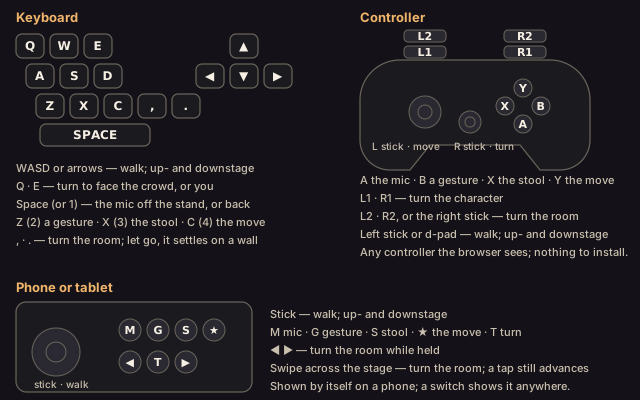
With the camera off, a character walks on when the room opens and stands where you would — eighteen to choose from, drawn live in a pane before you go on so you can turn them round and dress them, one of seven entrances picked each time, each running over ten seconds so it plays out with your walk-on music — and they react to what the room does, and their mouth moves while the room hears you talk: a take-in on a laugh, a shrug on a groan, a shift of weight in dead air, a glance at a heckler. You can move them, hand them the mic, sit them on the stool, give the room the setting's move (the look, open hands, a hand to heaven), and turn them to face the crowd or you. Turn the camera on and it is you on stage instead. It is scenery: the room measures your sound and nothing about them.
And the whole room is there. Every room is painted all the way round: the stage, the wall on one side — the wing, a door out, the side seats — the house, and the other wall. The comma and full stop keys turn you left and right; on a controller the triggers do, as far as you press them, and so does the right stick. Let go and it settles on the nearest wall; a small dial says which. The two views in Dress the stage are the two ends of that turn. The room has depth on the way round: the front row, the curtain legs and the wing sweep past faster than the walls behind them, the way near things do. On a phone or a tablet an on-screen pad appears over the stage — a stick to walk, the five buttons, two arrows for the room — and a swipe across the stage turns the room on any screen.
Nothing is uploaded
Audio is measured in the browser for loudness and timing and never leaves the machine. Nothing is saved unless you ask: Record the set keeps a take on your device — your voice, the room and the picture — to watch back in the recap with the laughs marked on the timeline, or to download; close the tab and it is gone. You choose where the take begins — at the walk-on, so the entrance is in it, or at the first beat, so it opens on your first line. The camera shows you under the light during a set, or as a lit silhouette in Silhouette view; the booth paints the room you picked around you — curtain, stool, mic stand — drawn on your own device over your own camera, with no model downloaded and nothing sent anywhere; movement is measured only when you turn Watch how you move on, and nothing about it appears anywhere otherwise.
Not just for comics
Half the built-in practice sets are speeches rather than stand-up: a best man toast, a retirement send-off, a milestone birthday. Pacing a speech is the same skill as pacing a bit, and a wedding is a tougher room than most open mics. If you have to be funny exactly once, this is the place to find out where you rush.
If you would rather see it work before pointing a camera at your own face, watch a scripted run first — a full set played through the real room with sound on, asking for no camera, no microphone and no account.
Take the stage